
Red Alert
A look at the Cowboys' red zone woes, and what they should expect moving forward.
Through four games, the Cowboys are 3-1. They’ve outscored opponents by 83 points, and outside of an anomaly in Arizona, they’ve allowed only a single touchdown against them, a long pass to Garrett Wilson against the Jets.
For all that success, though, there’s been a fair amount of teeth-gnashing going on related to the team’s struggles in the red zone. After all, what good is it to move the ball between the 20’s if you can’t punch it into the end zone when you get there? As CeeDee Lamb recently said, the Cowboys “ain’t going to get nowhere with three points.”
But just how much should the Cowboys worry? Is past performance an indicator of future failure? Does history say there’s no chance for things to change, or can the Cowboys cure what ails them?
The Ugly
Through the first four weeks of the season, the Cowboys are scoring a touchdown on just below 37% of their trips inside the opponent’s twenty. Yeah, that’s bad. But just how bad is it?
In modern terms, the nadir of the Cowboys offense came in 2015. Tony Romo broke his collar bone twice, and the team was forced to turn to the likes of Pretty Spiral Thrower Brandon Weeden, and Matt Cassel, aka Poor Man’s Alex Smith. It an Old Yeller season, one where you just wanted to be put out of your misery.
The current Cowboys are actually worse in the red zone than that squad. The Cassel-Weeden team converted 44.4% of their red zone trips into touchdowns, a full seven percent better than the new Texas Coast offense.
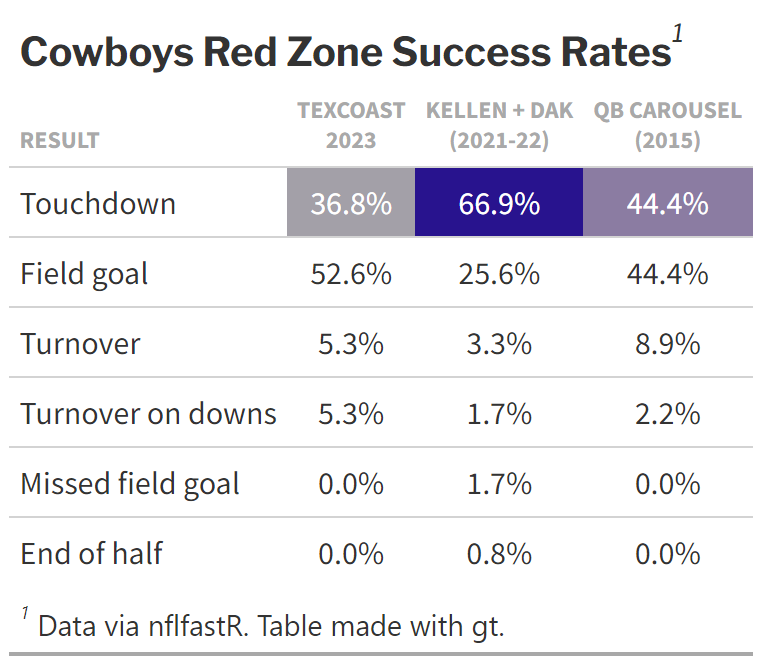
This season’s incompetence is only further emphasized when compared to the team’s more recent success. In the two full regular seasons following Dak Prescott’s return from his ankle injury, the team converted two of every three chances in the red zone into touchdowns.
Due to the failure to convert the red zone into the end zone, the Cowboys’ red zone scoring is also at a modern-era low. On average, the team is scoring 4.16 points per red zone drive, 6.3% lower than 2015’s 4.44 points. There is, however, something of a silver lining.
As mentioned above, the Cowboys have not struggled to move the ball between the twenties. In fact, they’re getting into the red zone at a rate unequaled over their recent history. In 2021 and 2022, the Cowboys averaged 3.82 and 3.29 red zone drives per game, respectively. This season, they are average a whopping 4.75 red zone drives per game, 70% better than the miserable 2015 season. They’re not being helped by field position, either. Despite the current defense’s penchant for generating turnovers, the average Cowboys red zone drive has started at their own 33, which is four yards worse than last year’s starting position.
That ball-moving ability isn’t just impressive when compared to other iterations of the Cowboys. It also stacks up against other NFL teams. The Chiefs under Patrick Mahomes and Andy Reid have become the paragon against which all NFL offenses are measured. Over the past two-plus seasons, they have maxed out at 4.29 red zone drives per game.1
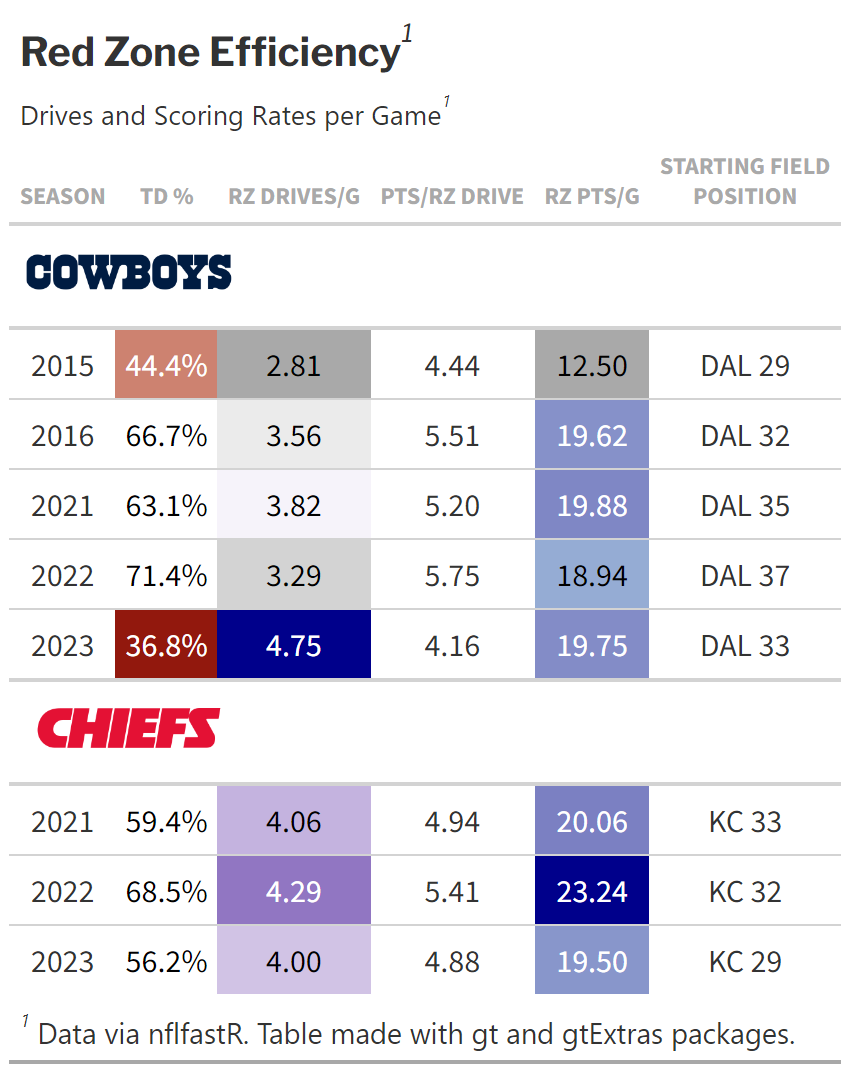
Thanks to this continued ability to move the ball, the Cowboys scoring in the red zone has actually held up. This season, they’ve averaged 19.75 red zone points per game, which compares favorably to all but the 2021 Cowboys offense. While still not peak Chiefs level, it’s still better than Kansas City has managed so far this season. After factoring in the fact that Dallas has done this against the Jets and Belichick’s Patriots, and that their first game was played in a rainstorm, it’s reasonable to maintain at least some positivity for the future.
After all, if they just flip their FG and TD conversion rates, they’re looking at two more points per game. With a defense built to play with a lead, that’s a scary proposition for opponents.
Past as Prologue?
The question remains, though, whether or not the first four games are a rough start or a sign of things to come. Past performance is not indicative of future success, as the old saying goes. But is it indicative of future failure?
Fortunately, we don’t have to guess at this. We can simply look at how other NFL teams have fared historically. If a team was woefully unsuccessful in the red zone to start the season, were they woefully unsuccesful over the rest of the year?
To do this, I pulled in regular season play-by-play data using the nflfastR package and calculated each team’s red zone TD rate over the first two games of the season and compared it to their red zone TD rate over the course of the remaining games. I then repeated the process using the team’s first four, six, eight, and ten games. The results are presented in the table below.
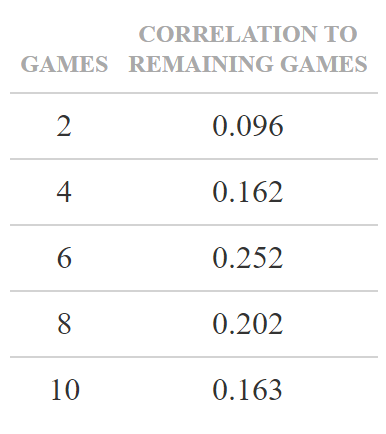
As shown, a team’s red zone success rate over its first 4 games of the season explained approximately 16.2% of its success rate over the remaining 12 (or 13) games. In other words, there is some signal in early season performance, but over a four game sample, most of the results are just noise. After all, an entire NFL season is an inherently small sample, not to mention just a quarter of it.
To show it differently, here’s each team’s first four game success plotted against its remaining season success. If there was a strong correlation, we’d expect these points to hover somewhere close to the diagonal line. Instead, we get something closer to a cloud of points with no clear direction.2 The trend line (shown in blue) is basically flat.
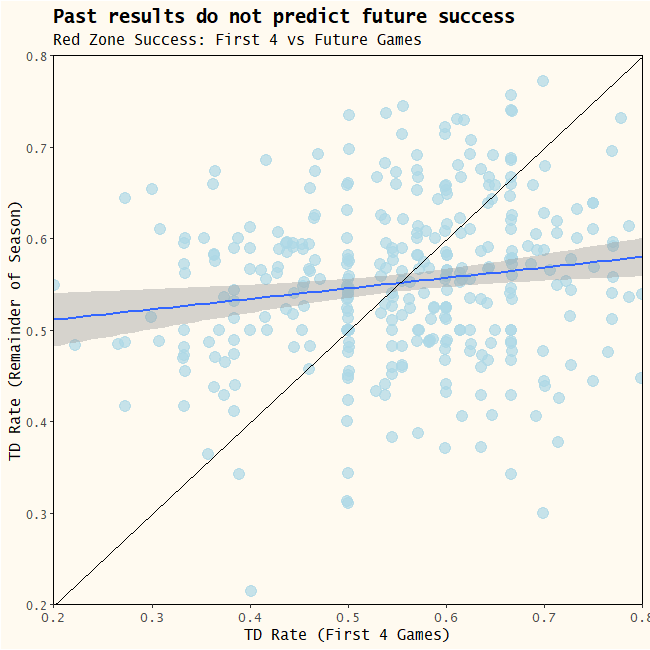
In other words, the Cowboys red zone issues may be bad, but they aren’t a death knell for the team moving forward. Plenty of teams that started out with red zone success rates below 40% went on to hit 50% and above over the remaining 12 to 13 games.
And based on their ability to move the ball now, that only spells good things for the future.
I get it, I get it. Explosive plays and whatnot. Still, being compared favorably in any offensive metric to Kansas City is a good thing, in my opinion.
As always, shoutout to the no-longer-active F5 Substack and the incomparable Owen Phillips for the theme here.