
Meet BEELO: An ELO-based Spelling Bee model
The 99th Scripps National Spelling Bee kicks off tomorrow. I set out to ask the question: What can I build with the data?
The first time I remember watching the Scripps National Spelling Bee was in high school. During exam week, we were allowed to leave early—usually around noon—when we’d finished testing. I went home and turned on ESPN, as was my custom, expecting to find Scott Van Pelt, Stuart Scott, or one of the other regular hosts on SportsCenter recapping the most recent batch of highlights.
Instead what I found were lines of elementary and middle school-aged children waiting their turn to spell words. At first, I was annoyed (how did this qualify as a sport?), but instead of changing the channel, I kept watching. And watching. When Akshay Buddiga, a 13-year old from Colorado Springs fainted while attempting to spell “alopecoid,”1 I knew I couldn’t stop until I saw how this ended.
Since that year, I’ve only missed the Bee twice: Once when it moved off of ESPN and I was using a TV subscription that didn’t include the competition’s new home, ION, and once when life simply got in the way and it slipped my mind.
Every Bee is different, and the type of excitement varies. Once the Bee ran out of words before it ran out of spellers, forcing them to crown eight co-champions. Twice the Bee has advanced to a spell-off to crown a champion.
But I’m not here to talk to you about why you should watch the Bee (and bee-lieve me, you should, this bad pun notwithstanding). Instead I’m here to talk to you about a tool you should be using while you watch the Bee. Because using all the data I could dig up on the internet, including 10 full results, plus 20+ years of word attempts, I build an app that might better help us see who’s got a real shot at winning this thing before we narrow it down to the finalists.
Meet BEELO: an ELO-based model for predicting the Spelling Bee.
How the Model Works
At its core, BEELO treats the Spelling Bee as a series of one-on-one matches between each speller and each word. Both spellers and words get ELO ratings, a concept you’re likely familiar with if you’ve ever played an online chess match before.
When a speller attempts a word:
The model calculates the probability of success based on the speller’s ELO minus the word’s difficulty ELO. If the speller was expected to get it right and does, their rating barely budges. If they succeed against the odds, their rating jumps. The same logic applies to words: if a word is rated 1600 (hard) and lower-rated speller got it right, we learn it’s probably easier than we thought, so it drops.
This makes the model self-correcting. A word that seems hard but is vanquished by a young speller in an early around will quickly adjust. A speller who stumbles on an easy word will take an ELO hit, not only eliminating them but also lowering their prior score in case they return next year.
Before the Bee: Building Priors
Word Priors
Every word has a history. We run the model backwards through 20+ years of word attempts to build a difficulty rating for every word ever used. A word’s difficulty depends on its round (championship words are harder than early ones) and its etymology—certain language origins (like Latin) tend to spawn harder words.
For new 2026 words we haven’t seen before, we predict their difficulty from their etymology and the typical difficulty of their round, so we start with a reasonable guess rather than assuming everything is average.
Speller Priors
Spellers coming back from 2025 start with their end-of-year ELO plus a boost for another year of growth (older kids typically improve). Spellers returning after a few years (i.e. a speller who appeared in 2024 but not 2025) get their most recent year’s ELO decayed toward their age/grade baseline (they’ve had time off, but not all their skill disappears). First-timers get an age/grade baseline based on historical performance of spellers their age.
This way, everyone starts the 2026 Bee with a personalized estimate of their skill—whether they’re experienced veterans, or first-time competitors.
What’s in the Shiny App?
During the Bee, the BEELO dashboard gives you a live, data-driven view of the competition as it unfolds. Here’s what each tab shows:
Win Probabilities
The main view when you open the app. You’ll see a table ranking every speller by their current odds of winning the championship, updated in real time. Above it are four quick stats: number of active spellers, current round, who the model sees as the favorite, and when the data was last refreshed. On the right, a chart of the top contenders lets you track how the favorites are separating from the pack. This is where you come to ask Who’s the favorite right now?

ELO Trajectories
For the deep dive: an interactive chart showing how individual spellers’ ratings climbed (or fell) as they spelled words throughout the competition. Each speller’s line shows every word they attempted—correct answers add points, incorrect ones subtract them. You can highlight your favorite spellers to follow their journey, or look at the top performers to see their path to victory. Filter to just active spellers, or adjust how many of the top finishers you want to see.
Round Details
Curious about a specific round? Pick it from the drop-down menu and see a breakdown of every word in that round—what it was, how hard it turned out to be, which spellers got it right, and how their ratings changed. A summary at the top explains how the round shaped the competition.
Word Difficulty
Every word in the Bee has a difficulty rating based on historical performance. This tab ranks the hardest words so far and shows how difficulty changes across rounds. In early rounds, words are easier (more attempts, higher success rates). As the Bee progresses, the remaining words get harder—championship-level words can have ELO ratings above 2000.
Meet the Spellers
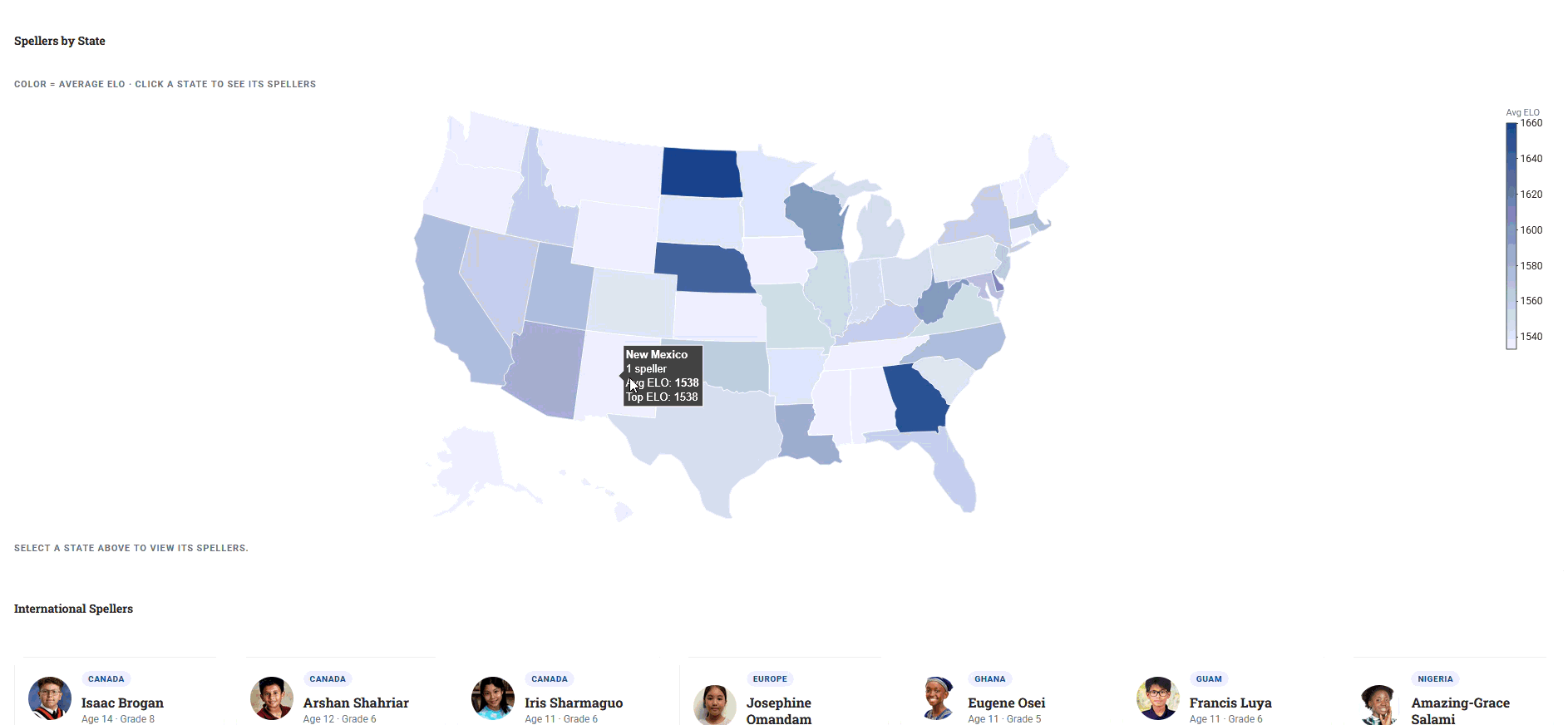
A visual tour of the competition. An interactive map shows which states’ spellers are competing and their average ELO (darker = stronger). Click a state to see detailed cards for each speller from there. A separate section highlights international competitors. Great for learning who the contenders are and where they’re from.
Model Info
Built into the app is an explanation of how the ELO model works, so you can understand what the numbers mean without digging into the technical details.
During the Bee: Live Updates
As each round begins, the app polls for results. When a speller spells a word, the ELO model updates instantly:
• The speller’s rating adjusts based on whether they succeeded or failed.
• The word’s difficulty rating updates to reflect how many spellers got it right or wrong.
• Win probabilities for all remaining spellers are recalculated—maybe your favorite speller just jumped from 8% to 12% odds.
The dashboard refreshes every minute, so you see the competition evolve in real time. As spellers eliminate themselves and the field narrows, the championship gets tighter—and the model’s confidence in the remaining contenders grows.
I hope you enjoy the Bee, and I hope you take a chance to check out BEELO. More importantly than that, I’m praying that the live updates manage to pull successfully. Fingers crossed!
In case you’re wondering, the model grades “alopecoid” as a 1617 in difficulty, which ranks it around in the top 1500 most difficult words out of 11,000+ on file.